

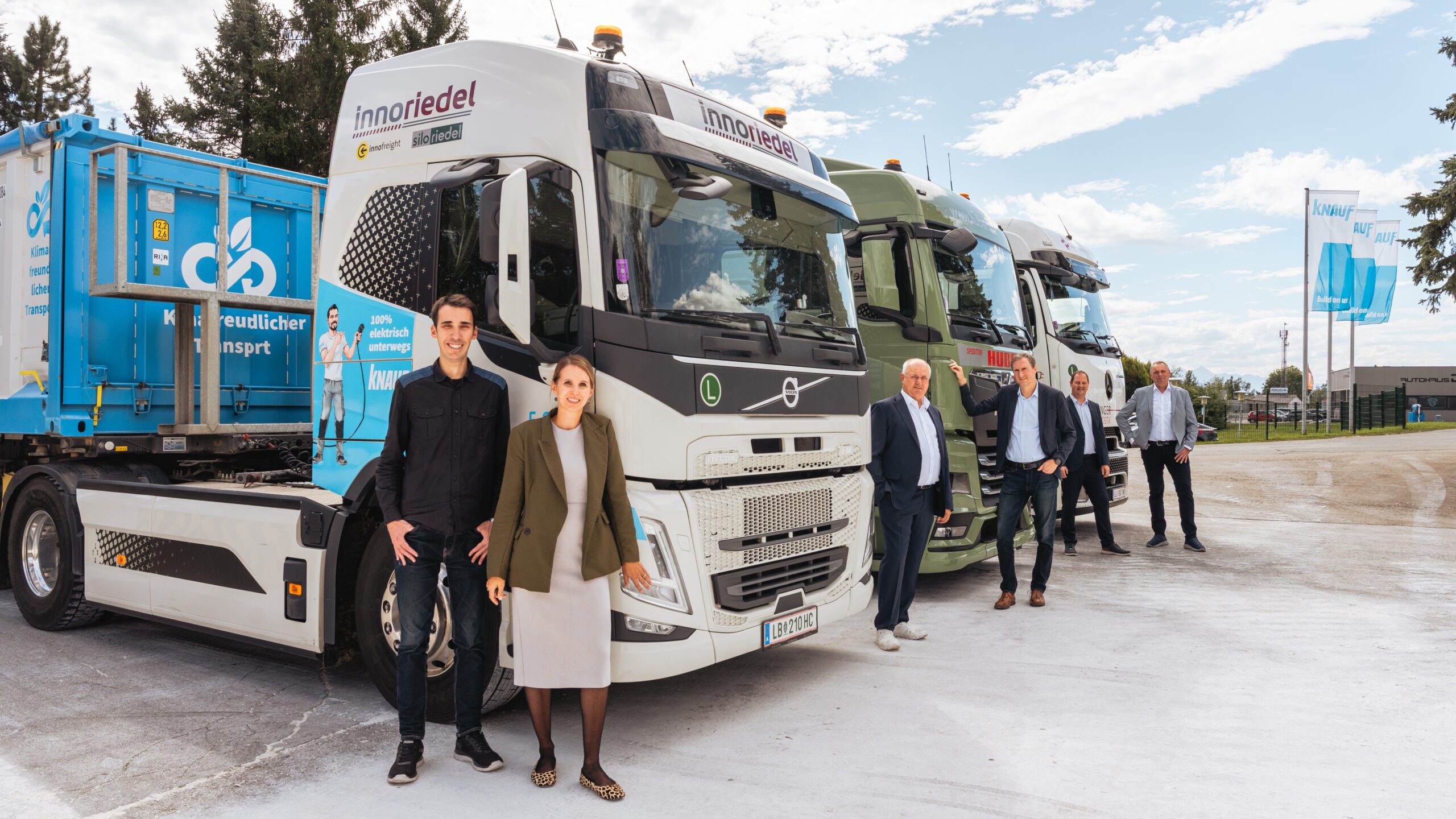


The Styrian building materials manufacturer Knauf aims to electrify the majority of its logistics operations by 2030. Innofreight is working closely with Knauf on this goal through the joint venture InnoRiedel and its fleet of electric trucks, after the partners made a strong statement in intermodal transport as early as 2024.
Winning the 2024 VCÖ Mobility Award in the “Climate-Friendly Freight Transport and Logistics” category marked a milestone in the decades-long collaboration between Innofreight and Knauf, which gained new momentum in the spring of 2024. Since then, a sophisticated logistics concept has been in use that combines electric trucks with rail transport to transport natural gypsum from Tragöß-St. Katharein to Weißenbach near Liezen for further processing. With this flagship intermodal project, which enables the transport of more than 100,000 metric tons of natural gypsum per year, the Styrian building materials producer launched its future logistics strategy and caused a stir throughout Austria.
“When we began implementing this logistics concept more than two years ago, we took on a pioneering role. Many benefit from this—first and foremost the local population, which is noticeably relieved of dust and noise thanks to the use of electric trucks,” emphasizes Hannes Pichler, managing director of InnoRiedel. Julia Heißenberger, authorized signatory at Silo Riedel—which, together with Innofreight, forms the joint venture InnoRiedel—adds that together they have succeeded in reducing CO₂ emissions along the entire logistics chain by 84 percent—compared to transport using diesel trucks alone. This reduction is made possible by the combination of electric trucks on the 30-kilometer feeder route and the 120-kilometer main leg by rail to Weißenbach near Liezen, where the natural gypsum is unloaded directly using a rotary unloading forklift from Innofreight.
Knauf is pursuing a clear strategy
The positive response to this project has reinforced Knauf GmbH’s commitment to further expanding its pioneering role in low-emission logistics and to electrify the majority of its logistics operations by 2030. “The fact that some of our contracted freight forwarders are already using electric trucks for Knauf shipments is a strong signal of the transformation taking place in logistics. Together with our partners, we are consistently driving forward the electrification of our transport chain and taking a decisive step closer to our goal of making the majority of our logistics low-emission by 2030,” explains Christoph Kaurzinek, Head of Logistics at Knauf, describing the strategy being driven forward together with Authorized Signatory Herbert Moser.
By combining various sustainable transportation solutions, Knauf aims to future-proof its logistics operations and consistently reduce CO₂ emissions throughout the supply chain. In addition to the increased use of electric trucks—the share of electric trucks in the fleet is expected to reach around 50 percent by 2030—rail transport will also make a significant contribution to this effort. As a result, the partnership between Knauf and Innofreight will continue to generate innovative transportation solutions along the entire logistics chain in the future.